
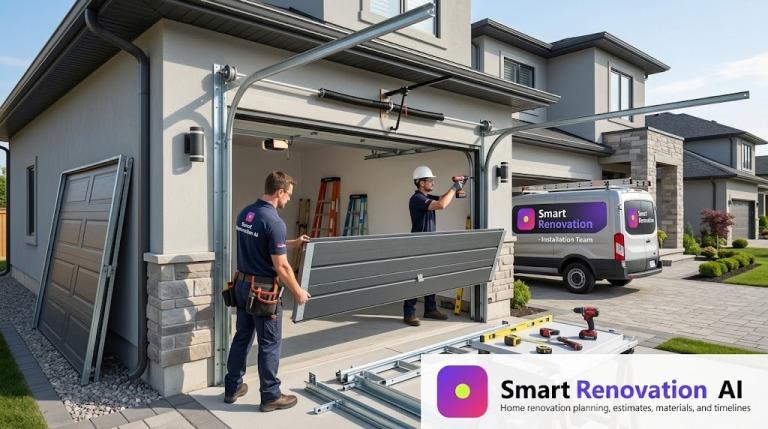
Garage & Exterior Renovation Costs
Garage Door Installation Cost in 2026: What You’ll Really Pay, Door by Door
A straight-talking, contractor-level breakdown of garage door installation pricing — by size, material, labor, and location — so you can read any quote and know exactly what’s fair.
If you’ve started calling around for quotes, you’ve probably already noticed the problem: one company tells you $700, another says $2,400, and a third wants to talk about “financing options” before you’ve even picked a color. None of them are necessarily wrong — garage door pricing genuinely spans that wide a range — but almost none of them explain why your project lands where it does.
This guide fixes that. We’re going to walk through every variable that moves a garage door installation cost up or down — door size, material, insulation, opener type, labor, your region, and the “extras” that quietly show up on the final invoice — so that by the end, you can look at any bid and know within a few hundred dollars whether it’s fair, inflated, or missing something important.
What’s in this guide
- Quick Answer: What Installation Actually Costs
- What a Professional Installation Quote Should Include
- Cost by Door Size (Single vs. Double)
- Cost by Material and Style
- Labor Costs and How Long Installation Takes
- Garage Door Opener Costs
- Commercial Garage Door Installation Cost
- Hidden Costs Most Quotes Leave Out
- How to Install a Garage Door: The Process, Step by Step
- How to Install Garage Door Springs (and Why to Think Twice)
- DIY vs. Professional Installation: An Honest Comparison
- How to Choose a Garage Door Company
- Regional Price Differences Across the U.S.
- 7 Ways to Lower Your Installation Cost Without Cutting Corners
- Is a New Garage Door Worth It? ROI and Resale Value
- Frequently Asked Questions
1. Quick Answer: What Installation Actually Costs
National average, installed
$1,400 typical range: $600 – $4,500
Most single-car garage doors, fully installed with standard hardware, land between $800 and $1,900. Two-car doors typically run $1,200 to $3,500. Custom carriage-style, oversized, or heavily insulated doors can push past $6,000–$10,000. Installation labor alone — separate from the door itself — usually adds $200 to $600 for a straightforward swap, or more if your framing, track, or opener wiring needs work.
Those numbers are a starting point, not a quote. The honest answer to “how much will my project cost” depends on four things, roughly in order of impact: the material you choose, whether it’s insulated, the size and number of doors, and how much extra work the opener, framing, or wiring requires. We’ll walk through each one so you can build your own realistic number instead of guessing between two bids that don’t seem to describe the same job.
Before you request quotes, it also helps to know your rough opening size. If you’re not sure how your garage door’s dimensions affect pricing, SmartRenovationAI’s door size calculator is a quick way to confirm measurements before a contractor ever shows up.
2. What a Professional Installation Quote Should Include
A lot of the confusion around garage door installation cost comes down to scope — two “installation” quotes can describe two very different jobs. Before comparing prices line by line, confirm the bid actually covers the full scope of work below. If it doesn’t, ask what’s missing and get it added in writing.
- Removal and disposal of the old door — panels, tracks, springs, and hardware hauled away, not left in your driveway.
- New door panels, tracks, and rollers — matched to your opening size and the door’s weight rating.
- Springs sized correctly for the door — torsion or extension, rated for the door’s actual weight, not a generic stock spring.
- Weatherstripping and bottom seal — installed and adjusted, not left loose.
- Balancing and safety testing — the auto-reverse sensors and force settings checked, not just “it opens and closes.”
- Basic hardware — hinges, brackets, and cables appropriate to the door style.
- A walkthrough — a quick demonstration of manual release, maintenance basics, and warranty paperwork.
What’s usually not included unless you ask: the opener itself (if you’re keeping your old one, confirm it’s compatible), electrical work if your outlet or wiring needs updating, permit fees where required, structural framing repairs, and insulation upgrades beyond what comes standard with the door. We’ll price all of those separately below so nothing catches you off guard.
A note on comparing quotes apples-to-apples
The fastest way to spot a lowball or an inflated bid is to line up two or three quotes against the same checklist. SmartRenovationAI’s contractor quote checklist walks through exactly what to compare beyond the bottom-line number — scope, warranty, timeline, and payment terms — so you’re not just picking the cheapest name on the page.
3. Cost by Door Size (Single vs. Double)
Size is usually the first thing that separates a $900 quote from a $2,800 one, simply because a two-car door uses roughly twice the material, a heavier spring system, and often a beefier opener to lift the extra weight.
| Door Size | Common Widths | Installed Cost Range | Typical Average |
|---|---|---|---|
| Single-car | 8–9 ft wide | $800 – $1,900 | ~$1,250 |
| Single-car, insulated | 8–9 ft wide | $1,200 – $2,600 | ~$1,700 |
| Double / two-car | 16 ft wide | $1,200 – $3,500 | ~$2,100 |
| Double, insulated or custom | 16–18 ft wide | $2,200 – $6,000 | ~$3,400 |
| Oversized / RV / commercial-residential | 10–14 ft tall, 10+ ft wide | $3,000 – $10,000+ | Varies widely |
If your home has two single garage doors instead of one double door, expect your total to sit closer to two separate single-door installations rather than one double-door price — most companies charge a small labor discount for a same-day second door (often 10–20% off the second unit’s labor), but the door material cost doesn’t change.
4. Cost by Material and Style
Material is the single biggest lever on price, and it’s also where the widest range in “garage door installation cost” search results comes from — a bare steel door and a custom wood carriage door aren’t really the same product category, even though they do the same job.
| Material / Style | Installed Cost Range | Best For |
|---|---|---|
| Steel, uninsulated | $700 – $1,800 | Budget-conscious replacements, detached garages |
| Steel, insulated (single or double layer) | $1,200 – $3,000 | Attached garages, moderate climates |
| Vinyl | $700 – $1,600 | Coastal areas, low-maintenance priorities |
| Composite / fiberglass | $1,000 – $3,000 | Wood look without wood upkeep |
| Aluminum & glass | $1,200 – $4,000 | Modern architecture, natural light |
| Wood | $1,500 – $5,500 | Historic homes, premium curb appeal |
| Custom carriage-style | $3,000 – $10,000+ | High-end resale markets, architectural statements |
A few things worth knowing before you fall in love with a style photo:
- Insulation adds real cost but also real value. A single-layer steel door with polystyrene backing might run a few hundred dollars more than a hollow door, while triple-layer insulation with a higher R-value can add $400–$900. If your garage is attached to living space, this is usually worth it for temperature control and noise.
- Faux wood beats real wood on lifetime cost. Composite and steel doors with wood-look overlays cost less upfront and require far less maintenance than solid wood, which needs re-staining or repainting every few years.
- Glass and aluminum doors trade insulation for light. They look striking but generally insulate less well than steel unless you pay for double-glazed panels — worth confirming if your garage is heated or attached.
- Hardware is a hidden style cost. Decorative hinges, handles, and faux-clavos (the decorative nail heads on carriage doors) can add $30–$300 to a project depending on how ornate you go.
If you’re also weighing exterior upgrades alongside the door itself, it’s worth checking how the new door will look against your siding, paint, and driveway — SmartRenovationAI’s exterior curb appeal planning tools can help you visualize the whole front-of-house look before you commit to a finish.
5. Labor Costs and How Long Installation Takes
Labor is the part of the bid homeowners tend to question most, mostly because it can look small compared to the door price — but it’s where the skill and safety of the job actually lives.
Straightforward swap
$200 – $600
Same opening size, no structural changes, existing opener reused or compatible. A two- to three-person crew typically finishes in 4 to 6 hours.
Complex installation
$600 – $1,200+
Framing repairs, opening resized, new track configuration, or first-time opener wiring. Can take a full day or run into a second visit.
According to U.S. Bureau of Labor Statistics wage data, the average hourly pay for a garage door installer sits in roughly the $17–$34 range depending on region and experience, which is why a two-to-three-person crew working four to six hours typically bills out in that $200–$600 labor band for a routine job. Complexity — not the installer’s hourly rate — is usually what pushes labor costs higher.
6. Garage Door Opener Costs
If you’re replacing the door but keeping the opener, confirm compatibility first — mismatched horsepower or an outdated opener without rolling-code security and auto-reverse safety sensors is a common reason installations get delayed. If you need a new opener as part of the project, here’s what to budget:
| Opener Type | Unit + Install Cost | Notes |
|---|---|---|
| Chain-drive | $300 – $500 | Reliable and affordable; noisier, best for detached garages |
| Belt-drive | $400 – $700 | Quieter operation, good for garages under living space |
| Smart / Wi-Fi enabled | $600 – $900 | App control, camera integration, smart-home compatible |
| Full opener installation labor (any type) | $218 – $540 | Mounting, wiring, sensor alignment, and safety testing |
Average total spend on opener installation — including the unit — tends to land around $379 for a mid-range chain or belt-drive system. Battery backup (useful during power outages) and rolling-code keypads typically add $50–$150 each. If you’re leaning toward a smart opener, it’s worth reviewing SmartRenovationAI’s smart home security planning resources to see how it fits into a broader connected-home setup.
7. Commercial Garage Door Installation Cost
Commercial garage door installation cost operates on a different scale than residential work, mostly because the doors themselves are heavier-duty, cycle far more often, and frequently need to meet specific fire, insulation, or automation ratings.
| Commercial Door Type | Installed Cost per Door |
|---|---|
| Basic roll-up steel (small shop, storage) | $1,500 – $4,000 |
| Sectional steel, standard | $2,500 – $5,000 |
| Insulated / heavy-duty sectional | $4,000 – $10,000 |
| High-speed or oversized (loading dock) | $10,000 – $25,000+ |
| Full commercial project (single door, all-in) | $5,000 – $15,000 typical |
A few things that move commercial pricing beyond what a homeowner deals with:
- Cycle rating — a door that opens 20 times a day needs stronger springs, tracks, and motors than one that opens twice a day, and that durability costs more upfront.
- Automation and access control — keypads, card readers, and integration with a building’s security system can add anywhere from a few hundred to several thousand dollars.
- Fire-rated doors — required in some commercial and industrial settings, these carry certification costs but may qualify for insurance-related savings.
- Scheduling around business hours — installers often charge a premium for after-hours or weekend work to avoid disrupting operations, which is common on retail and warehouse jobs.
Commercial installation labor typically runs $75–$150 per hour, with a simple job taking 2–4 hours and a complex, multi-door commercial project stretching across one to three days. Get at least three itemized commercial bids — the spread between low and high commercial quotes tends to be wider than residential, so a side-by-side comparison matters even more.
8. Hidden Costs Most Quotes Leave Out
This is the section that saves people the most money, because these are the line items that turn a “$900 quote” into a $1,400 invoice. None of them are scams — they’re just easy to forget when you’re comparing headline numbers.
| Extra | Typical Added Cost |
|---|---|
| Old door removal & disposal | $50 – $150 (often bundled) |
| Framing / structural repair | $150 – $800+ |
| Electrical work for opener outlet | $100 – $400 |
| Permit fees (where required) | $50 – $250 |
| Insulation upgrade | $150 – $600 |
| Decorative hardware | $30 – $300 |
| Keypad / smart lock accessory | $40 – $150 |
| Battery backup for opener | $80 – $200 |
Not every project hits every line item — a simple like-for-like swap might only involve the door and labor. But if your garage door opening is older, was never wired for an opener, or your framing has settled over the years, it’s smart to ask your contractor directly: “Is there anything about my specific garage that could add to this quote once you’re on site?” A contractor who answers that clearly, with real numbers, is one worth trusting.
9. How to Install a Garage Door: The Process, Step by Step
Whether you’re hiring a pro or seriously considering a DIY route, understanding how to install a garage door — the actual sequence of work — helps you evaluate quotes and know what “done right” looks like. Here’s the general process a professional crew follows for a standard sectional door:
- Remove the old door and hardware. Panels, tracks, springs, and cables come out completely. This is also when hidden framing damage or rot usually gets discovered.
- Inspect and prep the opening. The frame is checked for square, level, and structural soundness. Any rot or misalignment gets addressed before new hardware goes in.
- Install the track system. Vertical and horizontal tracks are mounted, leveled, and bolted to the frame and ceiling structure.
- Set the first panel and work upward. Sectional doors are built bottom-up, with hinges connecting each panel to the next as rollers slide into the tracks.
- Install the spring system. Torsion springs (mounted above the door on a horizontal shaft) or extension springs (running along the horizontal tracks) are sized to the door’s weight and installed under controlled tension. This is the single most dangerous step of the entire job.
- Attach cables and drums. These transfer the spring’s lifting force to the door and need to be evenly tensioned on both sides.
- Mount and wire the opener. The motor unit is secured to the ceiling, connected to the door via the trolley arm, and wired to a dedicated outlet.
- Install and align safety sensors. Photo-eye sensors near the floor must be aligned precisely — this is a federally mandated safety feature (per the Consumer Product Safety Commission) that prevents the door from closing on an obstruction.
- Balance and test the door. A properly balanced door should stay in place when disconnected from the opener and lifted halfway by hand. The installer adjusts spring tension until this is true.
- Run a full cycle test. Open and close several times, checking for smooth movement, correct auto-reverse function, and no unusual noise.
That full sequence is why “how to install garage door” tutorials often run longer than people expect — a garage door isn’t one product, it’s a small mechanical system with several interdependent parts that all need to be correctly tensioned and aligned together.
10. How to Install Garage Door Springs (and Why to Think Twice)
Safety first: this is the most dangerous step in the entire process
Garage door springs store hundreds of pounds of tension — enough to cause serious injury, broken bones, or worse if they release suddenly. Experienced technicians have been hurt doing this job. If you have any doubt about your ability to do this safely, hire a professional. What follows is for informational purposes so you understand what the process involves and what a fair repair quote should cover — not a substitute for hands-on training.
There are two spring types you’ll encounter when learning how to install garage door springs:
- Torsion springs — mounted on a metal shaft directly above the door opening, wound to create rotational tension. These handle more weight and are standard on most modern doors, but they’re also the more dangerous of the two to work with.
- Extension springs — run along the horizontal tracks on either side of the door and stretch to create lift. Common on older or lighter doors, and generally considered somewhat less hazardous, though still risky without safety cables.
The general process, at a high level
- Disconnect power and lock the door. Unplug the opener and secure the door in the closed or fully open position with locking clamps so it can’t move unexpectedly.
- Release existing tension gradually. Using solid steel winding bars (never a screwdriver or makeshift tool), tension is released in controlled quarter-turn increments.
- Remove the old spring(s). Once fully unwound, the spring is unbolted from the center bracket and slid off the shaft or unhooked from the track.
- Confirm the replacement spec. Wire diameter, coil length, and inside diameter must match your door’s weight and height — an incorrectly sized spring will leave the door unbalanced or dangerous to operate.
- Install the new spring. Slide it onto the shaft (torsion) or hook it into the pulley bracket and rear hanger (extension), always feeding any safety cable through the spring first.
- Wind to the correct tension. This typically takes 7 to 30 quarter-turns depending on door height and weight, done symmetrically on both sides for double-spring systems.
- Test the balance. Disconnect the opener and lift the door halfway by hand — it should hold its position. If it drifts up or falls, tension needs adjustment.
Even simplified, that’s seven steps where a mistake can mean a spring releasing with explosive force. A professional spring replacement typically takes 2–4 hours including safety checks, versus 4–8 hours (plus research and tool-gathering time) for a first-time DIY attempt — and that’s assuming nothing goes wrong. This is the one part of “how to install a garage door” where the cost of hiring a professional is genuinely one of the best-value decisions in home improvement.
11. DIY vs. Professional Installation: An Honest Comparison
🔧 DIY Installation
Saves: Roughly $200–$600 in labor on a basic swap.
Costs you: A full weekend (realistically 6–10+ hours for a first-timer), specialty tools you may not own, and real injury risk during spring tension work.
Best for: Confident DIYers replacing a non-structural, non-motorized panel or handling cosmetic hardware — not full door or spring installation.
👷 Professional Installation
Costs: $200–$600 in added labor for a standard job.
Gets you: Correct spring sizing and tensioning, a properly balanced door, calibrated safety sensors, warranty coverage, and a job typically finished same-day.
Best for: Nearly everyone — especially any job involving springs, opener wiring, or a resized opening.
If your DIY installation goes wrong, the math flips fast — you may end up paying full professional labor anyway just to have the mistake corrected, on top of whatever you already spent on materials. For most homeowners, DIY makes sense for cosmetic upgrades (new hardware, weatherstripping, a fresh coat of paint on a wood door) and professional installation makes sense for anything structural, spring-related, or opener-related.
12. How to Choose a Garage Door Company
Once you’ve decided to hire out the job, the garage door company you choose matters almost as much as the door itself — installation quality determines how long springs, tracks, and the opener last before needing service. Here’s what separates a reliable garage door company from one that’ll leave you calling around again in two years:
- Licensing and insurance. Ask directly for proof — a reputable company won’t hesitate to provide it. This protects you if something’s damaged during install.
- Manufacturer certification. Companies certified by the door and opener brands they install often qualify you for stronger manufacturer warranties.
- Written, itemized quotes. A trustworthy garage door company breaks down door cost, labor, hardware, and any add-ons separately — not one vague lump sum.
- Clear warranty terms. Look for both a manufacturer warranty on parts and a separate labor/workmanship warranty from the installer — typically 1–2 years, sometimes longer.
- Real local reviews. Recent reviews (last 6–12 months) tell you more about current crew quality than a company’s overall lifetime rating.
- Multiple bids. Get at least three quotes for anything beyond a basic swap. Price spreads on identical-sounding jobs can be surprisingly wide, and the middle bid is often — though not always — the best balance of quality and value.
If you want a structured way to run this comparison instead of eyeballing three PDFs, SmartRenovationAI’s guides on comparing contractor quotes and what to ask during your first contractor call both walk through the exact questions to ask before signing anything.
13. Regional Price Differences Across the U.S.
Where you live shifts garage door installation cost more than most people expect, mostly driven by local labor rates and cost of living.
| Region | Typical Adjustment | Why |
|---|---|---|
| Northeast | +15% to +25% | Higher labor rates, older housing stock with more framing repairs |
| West Coast | Mixed, often +10% to +20% in metros | High cost of living in major metro areas, lower in rural regions |
| Midwest | −10% to −15% | Lower labor costs, more standardized housing openings |
| Southeast | −10% to −15% | Competitive contractor market, lower cost of living |
These are general directional trends, not guarantees — a rural Northeast town can easily undercut a booming Southeast metro. Getting local quotes is still the only way to know your real number, but this at least sets expectations before you start calling.
14. 7 Ways to Lower Your Installation Cost Without Cutting Corners
- Choose a standard size. Custom-sized openings cost significantly more than standard 8′, 9′, or 16′ widths — if you’re building new or reframing, stick to standard dimensions where possible.
- Bundle the opener with the door. Installing both in one visit saves a second labor call-out compared to scheduling them separately.
- Time it outside peak season. Spring and early summer are the busiest (and priciest) months for garage door companies; fall and winter often bring better scheduling flexibility and pricing.
- Skip decorative hardware you won’t notice daily. Windows and faux clavos add curb appeal but also add hundreds of dollars — prioritize insulation and a quality opener first.
- Get exactly three quotes. Fewer, and you can’t tell if a price is fair; more, and you’re wasting everyone’s time comparing near-identical bids.
- Ask about manufacturer rebates. Insulated and energy-efficient doors sometimes qualify for local utility rebates — it costs nothing to ask.
- Maintain instead of replacing when possible. If your existing door’s panels are sound and only the opener or springs have failed, a targeted repair can cost a fraction of full replacement.
For that last point specifically, it’s worth reading through SmartRenovationAI’s breakdown on repair vs. replace decision-making for doors before assuming a full installation is necessary.
15. Is a New Garage Door Worth It? ROI and Resale Value
Garage door replacement consistently ranks among the higher-return home improvement projects tracked in national cost-vs-value studies, often recovering a large share of its cost at resale — frequently cited in the 80–95% range depending on the market and door quality. A few reasons it performs so well compared to other exterior upgrades:
- It’s the largest visible surface on many home façades. On homes where the garage door faces the street, it can account for a third or more of the visible front elevation.
- Buyers notice condition immediately. A dented, faded, or slow-operating door reads as deferred maintenance during a showing — even if everything else about the home is well cared for.
- Insulated doors reduce energy costs for garages attached to living space, which appraisers and energy-conscious buyers increasingly factor in.
- Security upgrades matter to buyers. Rolling-code openers and sturdier materials are a selling point in listings, not just a nice-to-have.
If you’re weighing this project against other exterior work on your list — siding, driveway resurfacing, or a paint refresh — SmartRenovationAI’s renovation cost estimator and home value ROI calculator can help you prioritize budget across the full project list rather than tackling one upgrade in isolation.
16. Frequently Asked Questions
How much does it cost to install a garage door on average?
Nationally, homeowners pay around $1,400 for a fully installed garage door, with most single-door projects landing between $800 and $1,900, and double-door projects between $1,200 and $3,500. Custom or heavily insulated doors can run $3,000 to $10,000 or more.
Is it cheaper to repair a garage door or replace it entirely?
Repair is almost always cheaper when the problem is isolated — a broken spring, a damaged panel, or a failed opener motor. Replacement makes more financial sense once the door is old, repair costs start approaching a large share of a new door’s price, or you want the energy efficiency and curb appeal a new insulated door provides.
How long does garage door installation take?
A standard single or double door replacement typically takes 4 to 6 hours with a two-to-three-person crew, assuming no framing repairs or major electrical work. Complex installations, resized openings, or commercial jobs can take a full day or longer.
Can I install a garage door myself?
Cosmetic and hardware-level work (weatherstripping, decorative hinges, painting) is reasonable for a confident DIYer. Full door installation and especially spring installation involve serious injury risk and precise balancing — most professionals recommend hiring this out, and many manufacturer warranties require professional installation to remain valid.
How much does it cost to replace garage door springs?
Professional spring replacement is typically a smaller line item than full door replacement, usually completed in 2–4 hours by a trained technician. Because springs must be sized precisely to your door’s weight and height, and because the job carries real injury risk, this is one repair where getting a professional quote is worth it even if you’re comfortable with other home projects.
What does commercial garage door installation cost?
Most commercial garage door installations run $1,500 to $7,000 per door, with basic roll-up steel doors at the lower end and insulated, high-speed, or oversized loading-dock doors reaching $10,000 to $25,000 or more. Labor for commercial jobs typically bills at $75–$150 per hour.
Do I need a permit to install a garage door?
It depends on your municipality and whether you’re changing the size of the opening. A like-for-like replacement often doesn’t require a permit, while resizing the opening or altering structural framing usually does. A reputable garage door company will know your local requirements and can pull permits on your behalf.
What’s included in a typical professional installation quote?
A complete quote should cover removal and disposal of the old door, the new door and matching hardware, correctly sized springs, weatherstripping, balancing and safety testing, and a final walkthrough. Electrical work, permits, and opener upgrades are often priced separately — confirm these upfront.
Related planning resources
- Garage renovation project hub — plan flooring, storage, and doors together
- Garage floor: tile vs. epoxy cost comparison
- Contractor quote checklist — compare bids the right way
- Full guide to reading contractor quotes
- Renovation budget tiers: what different price points get you
- Home improvement cost calculator
- Windows & doors project planner
Costs referenced in this guide are national averages compiled from multiple industry pricing sources and are intended for budgeting purposes. Actual quotes will vary by region, contractor, door specifications, and site conditions. Always obtain written, itemized quotes from licensed local contractors before starting a project.

One Comment