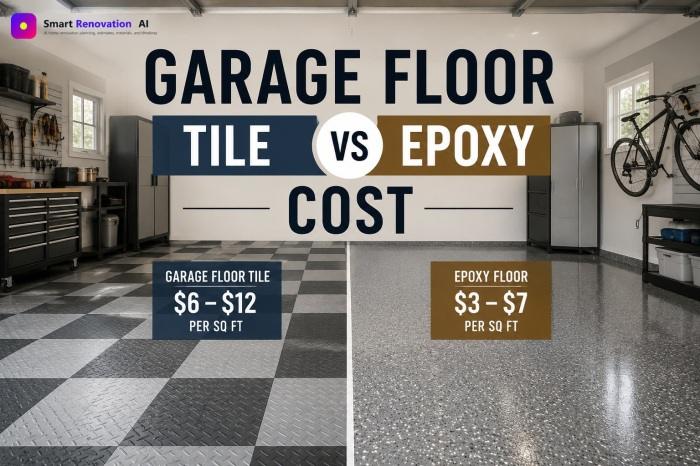
Garage floor tile and epoxy can both make a garage cleaner and easier to use, but they are not the same project. Tile is often a modular surface system. Epoxy is a bonded coating system. The best choice depends on slab condition, moisture, vehicle use, storage needs, and how much preparation the floor needs before the finish goes down.
A useful garage floor estimate should not price “flooring” as a generic interior item. Garage floors deal with tire heat, dust, oil, water, slope, tools, jacks, bikes, storage racks, and sometimes outdoor runoff. Those conditions change the material choice and the labor steps.
Tile vs Epoxy: The Main Difference
Garage floor tile usually sits on top of the slab. Interlocking tiles can hide minor cosmetic flaws and are easier to replace in sections. Epoxy bonds to the concrete, which can look seamless, but it depends on strong surface preparation. If the slab has moisture, oil contamination, loose concrete, or active cracking, epoxy can fail early.
| Decision point | Garage floor tile | Epoxy coating |
|---|---|---|
| Surface prep | Cleaning and basic leveling may be enough for some tile systems. | Grinding, crack repair, degreasing, and moisture checks may be needed. |
| Look | Patterned, raised, modular, or coin-style appearance. | Smoother finish with flakes, color, gloss, or satin options. |
| Repair | Damaged tiles can often be replaced individually. | Damaged coating may need sanding, patching, blending, or recoating. |
| Moisture sensitivity | Some systems allow airflow, but trapped moisture still matters. | Moisture vapor can cause bubbling or peeling if not addressed. |
| Installation timing | Often faster once the slab is clean and dry. | May require preparation, coating layers, and curing time before vehicles return. |
Cost Factors That Matter More Than The Finish Name
The word “epoxy” does not guarantee a premium floor, and the word “tile” does not guarantee a budget floor. The estimate should explain what is happening to the slab first.
Slab condition
Cracks, spalling, dusting concrete, old coatings, oil stains, and uneven areas can add preparation before either finish works well.
Moisture and drainage
Water under the door, damp walls, or vapor through the slab can influence whether coating or tile is the safer choice.
Vehicle and workshop use
Heavy vehicles, floor jacks, welding, chemicals, tires, and rolling cabinets should be considered before choosing a finish.
Edges and transitions
Garage door edges, steps, drains, wall edges, and driveway transitions can require trim or special detailing.
When Tile Makes More Sense
Garage floor tile can be a strong choice when a homeowner wants a fast visual upgrade, modular replacement, or a floor that can cover small cosmetic slab flaws. It can also be useful for garages that double as gyms, workshops, laundry areas, storage rooms, or hobby spaces. The estimate should include tile quantity, waste allowance, edge trim, threshold detail, and any leveling needed before installation.
Tile is not magic, though. If the garage has water intrusion, major unevenness, or a crumbling slab, tile may hide the problem instead of fixing it. A good quote should still inspect the slab and explain what preparation is included.
When Epoxy Makes More Sense
Epoxy can make sense when the concrete is sound and the homeowner wants a bonded, cleanable coating. The quote should describe grinding or profiling, crack repair, moisture testing if needed, primer, coating layers, flake broadcast if selected, topcoat, cure time, and when vehicles can return. A thin coating over dirty concrete is not the same as a properly prepared epoxy system.
| Epoxy quote item | Why to ask about it |
|---|---|
| Concrete grinding or profiling | The coating needs a suitable surface to bond. |
| Oil stain treatment | Oil contamination can weaken adhesion. |
| Crack repair | Cracks should be filled or explained before coating. |
| Moisture test | Moisture vapor can cause coating failure. |
| Topcoat | The top layer controls wear, cleaning, and finish quality. |
Photos To Upload Before Estimating
Take one wide photo from the driveway, one from the back of the garage, and close-ups of cracks, oil stains, floor edges, drainage, and the garage door threshold. If water enters after rain, photograph that too. These details help keep the estimate focused on garage flooring rather than unrelated renovation categories.
Maintenance And Warranty Questions
Garage flooring should be judged by how it performs after vehicles return, not only how it looks on installation day. Ask how tire marks are cleaned, whether hot-tire pickup is covered, how chemicals should be handled, and what voids the warranty. Tile and epoxy have different maintenance rules, so the quote should explain care in plain language.
For epoxy, the warranty may depend on slab preparation, moisture, coating thickness, and cure time. For garage tile, it may depend on tile rating, locking tab strength, installation surface, and how heavy loads are handled. A homeowner who uses the garage as a workshop should mention jacks, rolling cabinets, motorcycles, storage racks, or chemicals before choosing a finish.
| Use case | Planning detail | Why it matters |
|---|---|---|
| Daily parking | Tire heat, turning, moisture, and road salt or grit | The finish must handle repeated vehicle movement. |
| Workshop | Jacks, tools, chemicals, dropped parts, and rolling storage | Impact and chemical resistance become more important. |
| Storage garage | Shelving, boxes, bikes, laundry, and seasonal items | Edges, cleaning, and moisture control affect long-term usability. |
| Show garage | Appearance, pattern, gloss, color, and lighting | Finish detail may matter as much as basic durability. |
Questions To Ask Before Choosing
- Is the slab dry enough for the finish?
- Are cracks cosmetic or active movement?
- Will vehicles, jacks, tools, or chemicals be used on the floor?
- What happens at the garage door threshold?
- How long before the garage can be used again?
- What maintenance is expected after installation?
Build a scoped report with Smart Renovation AI before comparing tile, epoxy, coating, or repair quotes.
FAQs
Is garage floor tile cheaper than epoxy?
It depends on slab condition, tile type, and labor. Interlocking tiles can be faster to install, while epoxy can become costly when the slab needs grinding, crack repair, moisture treatment, or multiple coating layers.
Which garage flooring option lasts longer?
Both can last when installed correctly. Epoxy depends heavily on slab preparation and moisture control. Garage tiles depend on tile quality, locking system, load rating, and edge detailing.
Can epoxy be installed over a cracked garage floor?
Small cracks can often be repaired before coating, but active movement, moisture, or uneven slab conditions should be checked before choosing epoxy.
Are garage tiles good for heavy vehicles?
High-quality garage tiles can handle vehicle traffic when rated for the load, but cheap tiles may flex, separate, or mark under tires and jacks.
What photos help estimate garage floor work?
Useful photos show the full slab, cracks, oil stains, slope, garage door edge, drainage, wall edges, and any damp areas.