
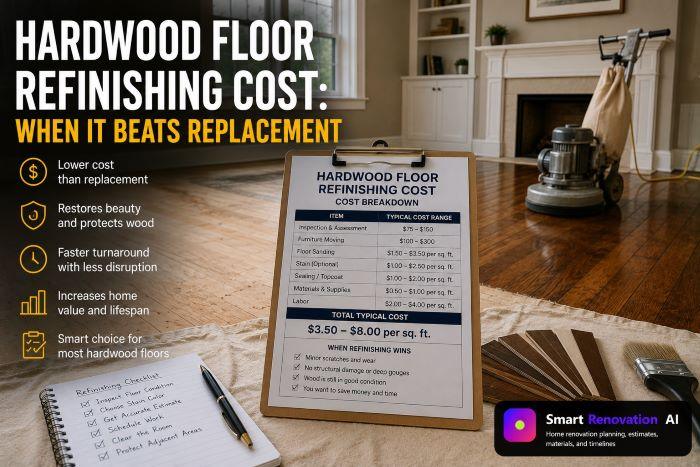
Hardwood floor refinishing cost depends on how much life is left in the floor and what the finish needs to become. Sanding, repairs, stain, finish coats, dust control, furniture moving, stairs, transitions, and drying time all affect the estimate.
The right question is not only “how much per square foot?” It is whether the floor can be refinished safely, how much repair is needed, and which finish process fits the home.
Refinish, Recoat, Or Replace?
Some floors need a full sand and refinish. Some only need a screen and recoat. Some are too thin, damaged, cupped, water-stained, or unstable and should be evaluated for repair or replacement. A good estimate should identify the path before pricing finish coats.
| Condition | Likely approach | Estimate note |
|---|---|---|
| Light surface wear | Screen and recoat may work. | Bonding test may be needed. |
| Deep scratches or worn color | Full sanding and refinishing. | Dust control and finish type matter. |
| Pet stains or dark water marks | Spot repair, board replacement, or stain strategy. | Some marks may not disappear fully. |
| Cupping or movement | Moisture and structure review first. | Do not sand before the cause is handled. |
| Thin engineered veneer | Limited sanding or replacement review. | Product thickness controls options. |
What A Refinishing Quote Should Include
- Measured floor area and rooms included.
- Furniture moving and protection.
- Sanding method and dust-control approach.
- Repairs, board replacement, gaps, or squeaks.
- Stain color or natural finish decision.
- Finish type and number of coats.
- Stairs, thresholds, vents, closets, and transitions.
- Drying time, odor, and re-entry guidance.
Repairs Before Sanding
Loose boards, missing pieces, exposed nails, squeaks, deep gouges, and damaged thresholds should be reviewed before sanding. If damaged boards are replaced, the contractor should discuss species, grade, age, grain, and color matching. New boards may not stain exactly like old flooring.
If the floor has moisture damage, do not rush to sanding. The source should be understood first. Related water-control planning may connect with waterproofing cost or plumbing repair if the stain came from an active leak.
Stain And Finish Choices
Natural finish, light stain, dark stain, matte finish, satin finish, water-based finish, and oil-based finish can change appearance, odor, drying time, durability, and maintenance. Dark stains may highlight sanding marks or dust if the process is rushed. Samples on the actual floor are more useful than choosing from a small chart.
Living Through The Project
Hardwood refinishing affects the home for several days. Rooms may be unavailable, furniture may need to move, pets may need a plan, and foot traffic may be restricted while finish cures. If the work includes stairs or the main entry path, ask how access will be handled.
Stairs, Borders, And Details
Stairs often cost more than flat floor area because each tread, riser, nosing, corner, and railing detail needs hand work. Borders, inlays, vents, closets, transitions, and tight hallways can add labor even when the total square footage is modest.
Photos To Upload
Show wide room views, scratches, dull finish, pet stains, water stains, loose boards, thresholds, stairs, vents, and sunlight fading. Include close-ups from low angles because gloss and scratches are easier to understand when light reflects across the surface.
When Replacement May Be Better
Replacement may make more sense when the floor is too thin to sand, badly water damaged, heavily patched, structurally weak, or the homeowner wants a completely different material. The flooring installation cost guide can help compare refinishing with new flooring.
How To Compare Refinishing Quotes
Compare sanding passes, dust-control method, repair allowances, stain samples, finish product, number of coats, drying time, furniture movement, stairs, closets, trim, and cleanup. A quote that includes repairs and multiple finish coats may be more complete than a lower price that only lists sanding and coating.
Color Expectations
Old hardwood can take stain unevenly because boards age differently, repairs may use newer wood, and previous stains can leave shadows. A sample patch is useful, but the final floor can still vary across rooms. If exact color matching is important, ask the contractor to explain limitations before work begins.
Odor, Dust, And Home Protection
Refinishing can involve dust, smell, noise, and restricted access. Ask how vents, cabinets, doorways, closets, electronics, and adjacent rooms will be protected. If anyone in the home is sensitive to odor, discuss finish type, ventilation, and when it is safe to return.
Timeline And Cure Time
Refinishing schedules depend on repair work, sanding, stain choice, finish type, number of coats, humidity, ventilation, and how soon furniture must return. Dry to touch does not always mean fully cured. Rugs, heavy furniture, pets, and shoes may need to stay off the floor longer than expected.
What The Estimate Should Not Add
A hardwood refinishing estimate should stay focused on the floor unless the customer asks for other work. It should not automatically include new cabinets, plumbing, roofing, or general remodeling. Relevant add-ons are trim touch-up, threshold repair, board replacement, stairs, floor vents, and moving furniture.
Before And After Photos
Photos are useful before refinishing and after each major stage. Before photos document damage and color expectations. After-sanding photos can reveal stains that remain. Final photos help compare finish quality, sheen, edges, corners, and transitions before furniture returns.
Keep the final product names and care instructions with those photos so future cleaning or touch-up work does not damage the new finish.
FAQs
What affects hardwood floor refinishing cost?
Floor area, condition, sanding depth, stain choice, finish type, repairs, dust control, furniture moving, stairs, and timeline affect cost.
Can all hardwood floors be refinished?
Not always. Veneer thickness, previous sanding, water damage, deep pet stains, movement, and thin boards can limit refinishing.
Is screen and recoat cheaper than full refinishing?
Usually yes, but it works only when the surface wear is light and the finish can bond properly.
Do stains and repairs add cost?
Yes. Dark stain, color matching, board replacement, gaps, squeaks, and water damage can add labor.
What photos help estimate hardwood refinishing?
Show wide room views, scratches, stains, worn finish, transitions, stairs, board damage, sunlight fading, and close-ups of problem spots.